Camping Gear Repair & Field Fixes: What to Pack So a Torn Tent Doesn't End Your Trip
A torn tent, busted zipper, or snapped pole shouldn't end your trip. Here's the ultralight field-repair kit every camper should pack, plus 8 emergency fixes you can do with gear you already have.
It was hour 3 of a 5-day backpacking trip in the Wind River Range. I was setting up camp when I heard it: rrrrip. A branch I'd missed while clearing the site had punctured a 4-inch gash through my tent fly. Rain was forecast for the next two days.
Three years ago, that would've been a trip-ender. But I'd learned the hard way that the wilderness doesn't care about your gear warranty. This time, I pulled out a roll of repair tape, fixed the tear in 60 seconds, and never thought about it again.
That tape is now the first thing I pack. Here's the complete field-repair kit I carry — and the emergency fixes that have saved real trips.
The 6-Item Ultralight Repair Kit (Under 8 oz, Under $25)
I've refined this kit over dozens of trips. Nothing here is dead weight — every item has bailed me out at least once.
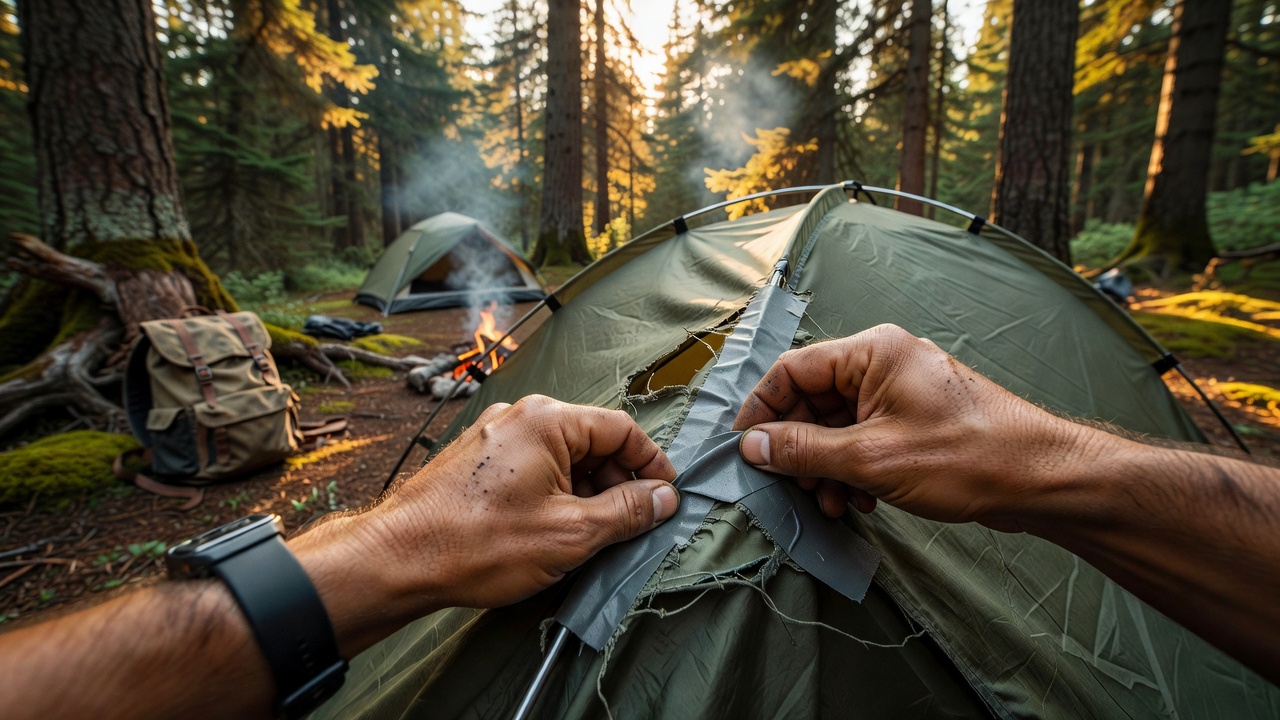
1. Repair Tape: The Non-Negotiable
Gear Aid Tenacious Tape is the gold standard for field fabric repair. It bonds permanently to nylon, polyester, vinyl, GORE-TEX, and basically any technical fabric your outdoor gear is made of — no sewing, no heat, no tools.
Price: $7.95
I carry a 3" x 20" strip and it's fixed:
- A 4-inch tent fly puncture (Wind Rivers, 2024)
- A down jacket tear that was hemorrhaging feathers (Sawtooths, 2023)
- A sleeping pad leak discovered at 11 PM (Uintas, 2022)
- A rain jacket hood that tore at the seam (Olympic Peninsula — fitting)
The tape is machine-washable once cured, so you can leave it on permanently. One roll weighs less than an ounce and slips into any pocket. There is zero excuse not to carry this.
2. Multi-Tool With a Saw and Pliers
A basic pocket knife won't cut it for repairs. You need something that can saw a branch for a splint, grip a bent stake, and handle actual mechanical work.
The Gerber Bear Grylls Ultimate Knife packs a half-serrated blade, needlenose pliers, wire cutters, and a saw into a single tool. The pliers alone have saved me from bent tent stakes and stuck zipper pulls more times than I can count.
Price: ~$45
What you'll actually use it for in the field:
- Sawing a tent pole splint from a tree branch
- Gripping a bent aluminum stake to straighten it
- Cutting paracord for emergency guylines
- The whistle on the lanyard (it's on there for a reason)
3. A Multi-Purpose Survival Tool
The UST Monarch 5-in-1 Survival Tool is tiny — about the size of a lighter — but combines a fire starter, whistle, compass, and emergency signal mirror. In a repair context, the fire starter is the MVP: if your stove fails, you can still boil water.
Price: ~$12
I keep this clipped to my pack's shoulder strap. It's the thing you hope to never use for survival but are grateful to have when Plan A falls apart.
4. Paracord (25 Feet)
A hank of 550 paracord weighs almost nothing and is the universal field fixer: emergency guylines, broken pack strap, lashing a splint, replacing a drawcord, hanging a bear bag when your dedicated line snaps. Get the real 7-strand stuff, not decorative cord.
5. A Headlamp You Can Work By
Repairs in the dark are twice as hard. A reliable headlamp like the Black Diamond Spot 400 gives you hands-free light for midnight tent surgery. 400 lumens is plenty to see what you're doing, and the red mode preserves your night vision — and your campmates' patience.
6. Seam Sealer (the Mini Tube)
A 0.25 oz tube of seam sealer weighs nothing and permanently fixes delaminating tent seams, leaky rainfly attachment points, and pinholes in sleeping pads. Apply at camp, let it cure overnight, and it's done. Most gear failures are seam failures — this fixes them at the source.
8 Emergency Field Fixes (Using What You Already Have)
You don't always have your full kit. Here are fixes using gear that's already in your pack:
1. Broken Tent Pole → Trekking Pole + Duct Tape Splint
Snap a tent pole and it's game over for your shelter — unless you improvise. Slide the broken section over a trekking pole, tape both ends, and guy it out. Your tent won't win any beauty contests but it'll stay standing through the night. The LEKI Makalu FX Carbon is light enough that emergency-tent-pole duty doesn't compromise its hiking performance.
2. Leaky Sleeping Pad → Soapy Water + Tape
Inflate the pad, mix water with a drop of camp soap, and brush it over the surface. Bubbles form at the leak. Mark it, dry the spot, apply tape. This works on Therm-a-Rest, NEMO, Sea to Summit — basically anything inflatable.
3. Stuck Zipper → Pencil Graphite or Lip Balm
Rub a pencil tip along the zipper teeth (graphite is a dry lubricant) or swipe lip balm on the track. Work the zipper slowly. This has revived zippers on sleeping bags, tent doors, and pack compartments.
4. Blown-Out Guyline Loop → Lark's Head Knot
When the sewn loop on a tent's guyline attachment tears out, don't panic. Tie a lark's head (also called a cow hitch) directly onto the tent body fabric, as close to the original attachment point as possible. It distributes force across the fabric instead of a single point and has held through 30+ mph winds for me.
5. Lost Tent Stake → Buried Stuff Sack
In sandy soil or loose gravel where stakes won't hold, fill a stuff sack with rocks or sand, tie your guyline to the drawcord, and bury it. The buried anchor has more holding power than most stakes in loose ground. I learned this on a beach camping trip in Oregon — stakes were useless in the sand but buried bags held through a full night of coastal wind.
6. Cracked Water Bottle → Duct Tape Patch + Boil-First Rule
If your primary water bottle cracks, tape the outside and treat it as a "carry only" container — don't drink directly from it until you can replace it. Switch to your backup hydration method. This is why I always carry a collapsible reservoir as backup.
7. Ripped Stuff Sack → Overhand Knot Closure
When the drawcord channel on a stuff sack tears, tie an overhand knot in the fabric itself to close it. Ugly but functional. The sack won't compress as well but your gear stays contained.
8. Melted Stove Hose → Boil Over Fire
If your canister stove hose melts or the regulator fails, you're not out of hot meals. Use the fire starter from your survival tool to build a small cooking fire, or balance your pot on rocks over hot coals. A Coleman Tabletop 2-in-1 Grill & Stove gives you backup cooking capability if you're car camping — it runs on propane and doesn't share a failure mode with your backpacking stove.
Prevention: The Repairs You Don't Have to Make
The best field repair is the one you prevented. Two things that dramatically reduce your odds of mid-trip gear failure:
Use a Footprint Every Time
A REDCAMP Waterproof Tent Footprint is a $25 insurance policy for your tent floor. It blocks sharp rocks, sticks, and abrasive ground that wear through tent fabric over time. It also adds a waterproof barrier between your tent and wet ground — condensation under your sleeping pad is a slow gear-killer that you won't notice until morning.
Check Your Tent Before You Leave
Set up the tent in your yard or living room the week before a trip. Check every seam, zipper, pole section, and stake loop. Repairs at home take 10 minutes and last forever. Repairs in the field at 9 PM in the rain take 45 minutes and might fail.
Common Camping Repair Mistakes (Learn From Mine)
"Duct tape fixes everything"
Duct tape is great — for hard surfaces. On fabric, it leaves residue, peels in humidity, and fails after one rain. Gear Aid Tenacious Tape is designed for fabric and stays put through storms and laundry. Carry both: duct tape for poles and hard goods, fabric tape for tents and jackets.
"I'll just sew it when I get home"
A 2-inch tear in a tent fly becomes a 12-inch rip after one windy night. Small damage compounds fast in the backcountry. Fix it immediately, even if the fix is ugly.
"My gear is new, I don't need repair supplies"
Brand-new gear fails too — sometimes more often because manufacturing defects haven't surfaced yet. A seam that looked fine in the store can separate on its first pitch. New gear is not a reason to skip the repair kit.
"A repair kit is heavy"
This entire kit — tape, paracord, seam sealer, multi-tool, survival tool — weighs under 8 ounces. That's less than a half-full water bottle. The weight-to-peace-of-mind ratio is unbeatable.
What's In Your Repair Kit?
The items above have gotten me through torn tents, busted zippers, leaky pads, broken poles, and stove failures across hundreds of miles of trail. The total cost for all six items is about $85 — less than most people spend on camp chairs — and the total weight is half a pound.
If you carry nothing else, carry the Gear Aid Tenacious Tape. It costs $7.95, weighs less than an ounce, and has saved more camping trips than any other single item in my pack.
Pack it. Hope you never need it. Be grateful when you do.
<!-- AFFILIATE_DISCLOSURE -->