Best Camp Stoves 2026: Backpacking to Family Car Camping — Which One Actually Fits Your Trip?
MSR PocketRocket 2 vs Camp Chef Everest 2X vs Coleman RoadTrip 225 — real camp stove comparison for backpacking, family car camping, and tailgating in 2026. Plus fuel guide and common mistakes.
Best Camp Stoves 2026: Backpacking to Family Car Camping
Here's a mistake I've made exactly once: carrying a dual-burner propane stove three miles into a backcountry site. By mile two, I was fantasizing about cold granola bars and questioning every life decision that led to that moment.
The right camp stove changes everything. The wrong one? You're eating cold beans out of a can while your buddy fires up a hot breakfast in three minutes flat.
This guide breaks down the three stoves we actually recommend — one for ultralight backpackers, one for family car campers, and one for the tailgating crowd. No filler, no 47-stove comparison grid. Just the right tool for your kind of trip.
The Three Types of Camp Stoves (And Which Trips They're For)
Before we get to specific models, let's sort out the three categories. Pick the wrong category and no amount of BTUs will save your trip.
Canister stoves (backpacking): Screw onto an isobutane canister. Weigh under 3 ounces. Boil water in 3 minutes. Useless for cooking anything more complex than rehydrating a meal. This is the MSR PocketRocket 2's territory.
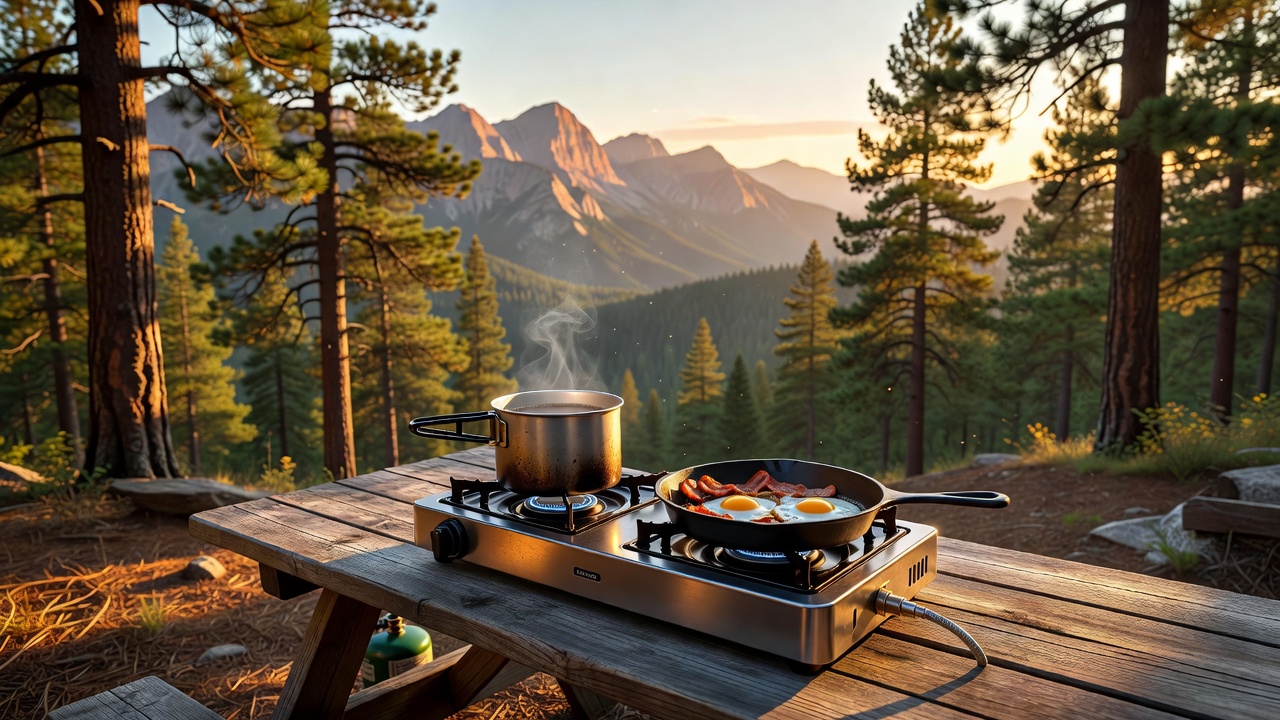
Dual-burner propane stoves (car camping): Two burners, a folding case, runs on those green 1-pound propane canisters. Simmer, boil, and actually cook — pancakes on one burner, coffee on the other. This is where the Camp Chef Everest 2X lives.
Tabletop propane grills (tailgating/car camping): A full grilling surface plus a side burner. Burgers, steaks, kebabs — the Coleman RoadTrip 225 is the gold standard here. Not for backpacking. Definitely not for backpacking.
Got your category? Let's look at each stove.
Best Backpacking Stove: MSR PocketRocket 2
MSR PocketRocket 2 Ultralight Backpacking Stove — $49.95
The PocketRocket 2 is the stove you see on every PCT and AT gear list for a reason: 2.6 ounces, boils a liter of water in 3.5 minutes, and folds down smaller than a deck of cards. It screws directly onto an isobutane canister (not included) and has a serrated pot support that grips your cook pot so it doesn't slide off mid-boil.
What it's great at: Boiling water for freeze-dried meals, oatmeal, and coffee. It's the definition of a one-trick pony — and that trick is exactly what you need at 12,000 feet when all you want is hot water.
What it's not: Simmering. Sautéing. Anything involving a pan. The flame pattern is concentrated and hot — great for a fast boil, terrible for delicate heat control. If you want to actually cook at camp, skip to the next section.
Who it's for: Backpackers, bikepackers, and anyone counting grams. Pair it with a Sawyer Squeeze water filter and a Nalgene 32oz bottle and you've got a complete backcountry kitchen under 10 ounces.
Rating: 4.7★ from 3,800+ reviews. When nearly four thousand people agree on a $50 stove, pay attention.
Best Family Car Camping Stove: Camp Chef Everest 2X
Camp Chef Everest 2X 2-Burner Portable Camping Stove — $58.99
The Everest 2X is the stove that makes car camping feel like you brought your home kitchen outside. Two 20,000-BTU burners — that's more heat output than most home stoves — with individual controls that actually let you simmer on one side while you boil on the other.
The simmer thing is not a small deal. Most camp stoves have two settings: "off" and "volcano." The Everest 2X's flame control is genuinely good — you can actually make scrambled eggs without burning them into a blackened crust. Pancakes on the left, coffee perking on the right. This is how family camping mornings should work.
Durability note: The stainless steel drip tray catches spills and pulls out for cleaning. The three-sided windscreen is built in. The whole thing folds into a briefcase-sized case with a latch. No loose parts rattling around your trunk.
The tradeoff: It weighs 12 pounds. It runs on 1-pound propane canisters (you'll want 2-3 for a weekend trip). This thing is for car camping — period.
Who it's for: Families of 3-6, group campouts, anyone who wants to cook real meals at camp. If you're making chili, pancakes, or pasta — not just boiling water — this is your stove.
Rating: 4.7★ from 450+ reviews. Fewer total reviews than the PocketRocket because the car-camping crowd reviews stoves less obsessively than the ultralight crowd. The rating tells the truth.
Best Tabletop Grill for Tailgating: Coleman RoadTrip 225
Coleman RoadTrip 225 Portable Tabletop Propane Grill — $149.99
The RoadTrip 225 is the grill that turns a parking lot into a cookout. 225 square inches of grilling surface, a side burner for your pot of beans or coffee, and legs that fold out into a stable stand. It runs on a standard 1-pound propane canister (or a 20-pound tank with an adapter hose, sold separately).
What sets it apart: The grilling surface is actually good. Many portable grills have uneven heat zones — a scorching hot spot in the center and a cold ring around the edges. The RoadTrip's burner design spreads heat evenly enough that you're not playing "rotate the burgers" the entire time.
The side burner is the secret weapon: Grill your burgers on the main surface while your beans simmer on the side. Or boil water for coffee while the grill preheats. Dual-zone cooking on a portable setup is rare at this price.
What it's not: Lightweight. At 28 pounds, this is firmly in the "roll it from the trunk to the picnic table" category. Also, the grates need seasoning like cast iron — skip this step and everything sticks.
Who it's for: Tailgaters, RV campers, and car campers who want grilled food, not just boiled/rehydrated meals. If your camp cooking vision involves burgers with grill marks, this is your answer.
Rating: 4.6★ from 11,500+ reviews. Eleven thousand people don't lie about a grill.
Budget Alternatives Worth Considering
Can't swing the MSR or Coleman price? Here are two solid alternatives — these aren't in our full catalog, but they're worth checking on Amazon:
- Jetboil Flash (~$109.95 on Amazon) — Integrated stove + pot system. Boils faster than PocketRocket (100 seconds for 2 cups) but weighs more and costs double. Best if speed is your priority, not weight.
- Coleman Triton 2-Burner (~$89.99 on Amazon) — A more basic dual-burner than the Everest 2X. Lower BTUs (11,000 per burner vs 20,000), less wind protection, simpler controls. Fine for occasional weekenders; serious cooks should save for the Everest.
Camp Stove Fuel Guide: Propane vs Isobutane vs White Gas
Choosing the right fuel is half the battle. Here's the quick version:
Isobutane canisters (backpacking): Lightweight, clean-burning, works in freezing temps (down to about 20°F). The MSR PocketRocket 2 uses these. $5-7 per 4oz canister. One 4oz canister = ~60 minutes of burn time — enough for a 3-day solo trip.
Propane 1-pound cylinders (car camping): Cheap ($3-4 each at Walmart), widely available, burns hot. The Camp Chef Everest and Coleman RoadTrip use these. One canister lasts about 1-1.5 hours on high. Bring at least two for a weekend.
White gas / liquid fuel (winter camping): Works in extreme cold (below 0°F) where canister stoves fail. Requires priming and more maintenance. Not covered in this guide because most people never camp in those conditions — if you do, you already know what you need.
The rule: Match fuel to season. Isobutane for three-season backpacking, propane for car camping year-round, white gas only if you're camping on snow.
5 Common Camp Stove Mistakes I've Made (So You Don't Have To)
1. Bringing the wrong stove for the trip
Isobutane stove on a family car-camping trip? You'll spend 45 minutes boiling water in batches while your kids ask when dinner is. Dual-burner on a backpacking trip? Your back will never forgive you. Match stove to trip type — the categories above exist for a reason.
2. Not checking the windscreen situation
Wind kills boil time faster than altitude. The PocketRocket 2 needs a separate windscreen (or a well-placed rock). The Everest 2X has a built-in three-sided shield. If you're cooking in Wyoming, factor this in.
3. Running out of fuel on night two
One 1-pound propane canister seems like plenty — until you're making a big breakfast, a hot lunch, and dinner on the same canister. Bring one more than you think you need. The spare costs $3; cold dinner costs your morale.
4. Cooking inside the tent vestibule
Don't. Just don't. Carbon monoxide + enclosed space = bad. Cook at least 10 feet from your tent, even in rain. Bring a tarp for a cooking shelter if weather is an issue.
5. Forgetting the lighter
Every stove has a Piezo igniter. Every Piezo igniter eventually fails. Pack a flame bird electric lighter or a simple Bic as backup. Nothing is more frustrating than a full fuel canister and no way to light it.
What Else You Need: The Camp Kitchen Ecosystem
A stove alone doesn't make a kitchen. Here's what completes the setup:
- Cookware: A nesting pot set that fits your stove. For the PocketRocket, a single titanium pot. For the Everest, a full UCO 4-Piece Mess Kit ($24.99).
- Water: Sawyer Squeeze ($34.99) for backcountry filtering. Nalgene 32oz ($16.99) as your unbreakable bottle.
- Cleanup: Biodegradable soap, a scrub pad, and a small towel. Pack-in-pack-out means washing dishes 200 feet from water sources.
- Coffee setup: AeroPress Go or a simple pour-over cone. Coffee tastes better at 7,000 feet. This is scientific fact.
The Bottom Line
| Trip Type | Best Stove | Price | Weight |
|---|---|---|---|
| Solo backpacking | MSR PocketRocket 2 | $49.95 | 2.6 oz |
| Family car camping | Camp Chef Everest 2X | $58.99 | 12 lbs |
| Tailgating & grilling | Coleman RoadTrip 225 | $149.99 | 28 lbs |
The PocketRocket 2 is the lightest, cheapest, and most specialized — it does one thing perfectly. The Everest 2X is the best value for families who cook real meals. The RoadTrip 225 costs more but brings grill marks to the campsite, and for some people, that's worth every penny.
Match the stove to the trip, pack an extra fuel canister, bring a backup lighter, and cook at least 10 feet from your tent. Follow those four rules and every camp meal will be a good one.
Related: If you're also shopping for a tent, start with our Camping Tent Size Guide — it's our most popular article for a reason.
<!-- AFFILIATE_DISCLOSURE -->