Camp Stove Fuel Guide 2026: Propane vs Isobutane vs Butane Explained
Confused about camp stove fuel? Compare propane, isobutane, and butane canisters for 2026 — cold-weather performance, BTU output, cost, and which stoves use what fuel. Complete guide for car campers and backpackers.
You're standing in the camping aisle staring at a wall of fuel canisters — green propane bottles, red isobutane canisters, blue butane cartridges — and the guy next to you grabs one without looking. You grab one that "looks right." Fast forward to 6 AM at a 40-degree campsite and your stove is sputtering out before your coffee water even simmers.
Camp stove fuel isn't complicated once you understand the basics. But choosing wrong can mean cold oatmeal, a stove that won't light, or a canister that runs out mid-meal with no backup. This guide breaks down the three main camp stove fuels — what they are, what stoves they work with, how they perform in different conditions, and what to buy for your setup.
Propane: The Car Camper's Workhorse
Propane is the green 1-pound canister you see at every grocery store and gas station. It's the most widely available camp fuel in North America, and for good reason.
Why Choose Propane
Availability: You can buy propane canisters at Walmart, REI, hardware stores, gas stations, and even some grocery stores. If you forgot fuel on the way to the campground, propane is what you'll find.
Cold weather performance: Propane vaporizes down to -44°F — far below any temperature you'll camp in. Your stove lights reliably at 20°F, 0°F, and everywhere in between.
BTU output: Propane delivers roughly 21,500 BTU per pound — the highest heat output of the three fuels. Water boils fast.
Value: At about $4-5 per 1lb canister, propane is the cheapest per-BTU fuel option for car camping.
The Tradeoffs
Propane canisters are heavy (1lb each for the canister plus fuel) and bulky. They don't pack down — what you buy is the full weight you carry. For backpacking, propane is almost never the right choice. The green canisters are also single-use (though some campgrounds have recycling programs, most end up in the trash). And propane stoves tend to be larger — they're designed for base camp, not your backpack.
Stoves That Use Propane
Coleman Triton 2-Burner Propane Camping Stove ($84.99) — The definitive 2-burner car camping stove. Two independently controlled 11,000 BTU burners on a wind-blocking frame. Uses standard 1lb propane canisters (or a 20lb tank with an adapter hose). This is the stove I recommend for family camping — enough power to boil pasta water and simmer sauce simultaneously, and the matchless ignition works reliably.
Coleman RoadTrip 225 Portable Tabletop Grill ($199.99) — A proper portable propane grill, not just a stove. 11,000 BTUs, 225 square inches of grilling surface, collapsible stand, and wheels for rolling it around camp. This replaces your backyard grill on the camping trip — burgers, steaks, grilled vegetables all come out with real grill marks. Connects to 1lb canisters directly or 20lb tanks with an adapter.
Coleman Tabletop 2-in-1 Grill & Stove ($89.99) — The hybrid: one side is a grill grate, the other side is a stove burner. Grill your sausages while heating beans on the burner side. Perfect for couples or small families who want grill flavor without hauling two separate appliances. Uses standard 1lb propane.
Camp Chef Everest 2X 2-Burner Portable Stove ($189.99) — The premium 2-burner. Dual 20,000 BTU burners (nearly double the Coleman Triton's output), a built-in matchless ignition, and a design that blocks wind better than any stove in its class. If you cook seriously at camp — stir-fries, seared steaks, multi-pot meals — the Everest is the upgrade pick. Uses 1lb propane canisters.
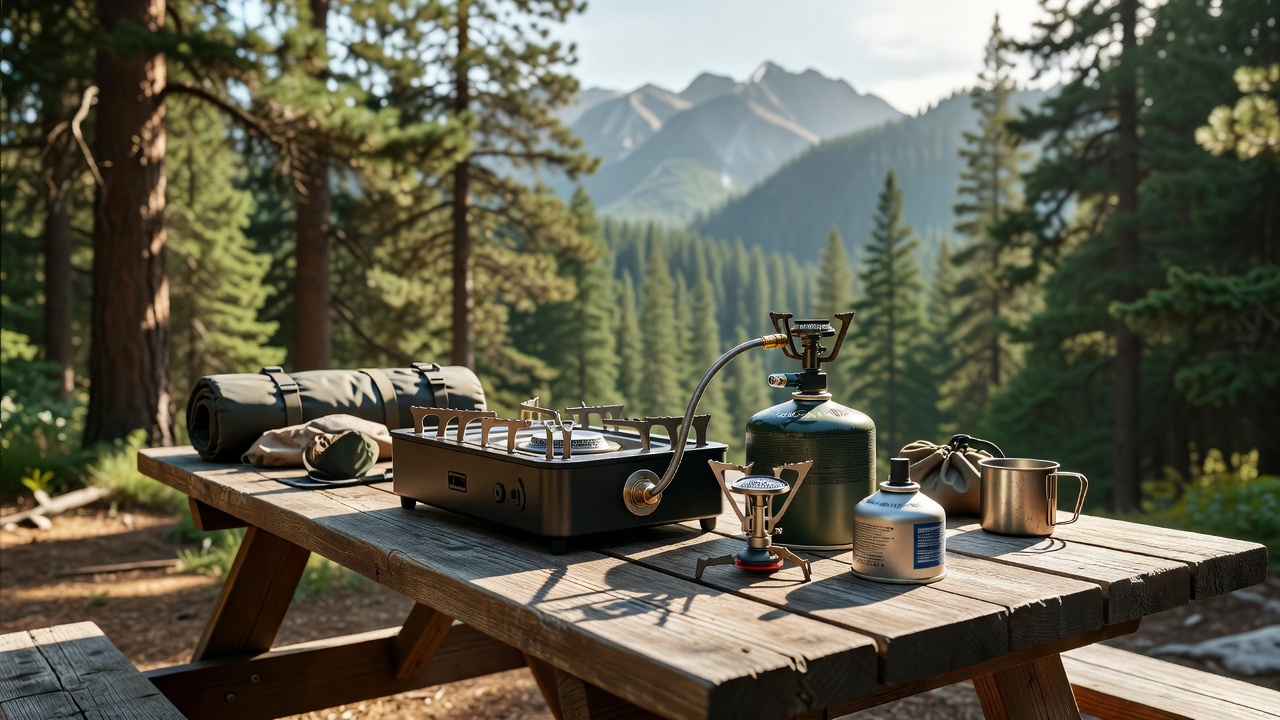
Isobutane: The Backpacker's Choice
Isobutane comes in those red-and-silver pressurized canisters with a threaded Lindal valve on top. It's the standard fuel for ultralight backpacking stoves, and for good reason.
Why Choose Isobutane
Weight-to-performance: An 8oz (227g) isobutane canister weighs about 13oz total and boils 12-15 liters of water — enough for a 3-day solo trip. For backpacking, this weight efficiency is everything.
Precision: Isobutane stoves give you fine flame control — from a jet-engine boil to a low simmer for rice or dehydrated meals.
Simplicity: Screw the stove onto the canister, open the valve, light it. No priming, no pumping, no liquid fuel to spill.
The Tradeoffs
Isobutane performs poorly in cold weather. Below 40°F, canister pressure drops and flame output weakens. Below 20°F, many isobutane stoves won't light at all or produce a flickering, useless flame. (There are tricks — keeping the canister in your sleeping bag overnight, using a 4-season canister mix — but propane is simply better in cold.)
Isobutane canisters are also less universally available than propane. You'll find them at REI and outdoor retailers, but not at rural gas stations. And at about $5-7 per 8oz canister, they're more expensive per BTU than propane.
Stoves That Use Isobutane
MSR PocketRocket 2 Ultralight Backpacking Stove ($48.95) — The iconic backpacking stove. Weighs 2.6oz, folds into a package smaller than a deck of cards, and boils a liter of water in under 4 minutes. The PocketRocket 2 screws directly onto isobutane canisters and has been the go-to for thru-hikers and weekend backpackers for a decade. Wind performance is decent but not great — bring a foil windscreen.
Jetboil Flash Camping & Backpacking Stove System ($119.95) — The integrated system approach. Jetboil's FluxRing technology wraps the pot in a heat exchanger, so it boils water in about 100 seconds — nearly twice as fast as a PocketRocket. The insulated cozy means you can hold the pot immediately after boiling. It's a system (stove, pot, cozy) rather than just a stove head, so it's bulkier but the speed and fuel efficiency are unmatched. Uses isobutane canisters.
Butane: The Niche Player
Straight butane canisters (the tall, narrow blue cartridges) are common in Asian and European markets but rare for North American camping. They use a different valve type — a clip-on or puncture-style connector rather than a threaded Lindal valve.
Why (and Why Not) Choose Butane
Butane delivers slightly less heat than propane (about 21,000 BTU/lb vs 21,500) and costs about the same as isobutane. The real issue is temperature: butane stops vaporizing at 31°F — just below freezing. Camp in the 30s and your butane stove is a paperweight.
Butane's one advantage is that it's available internationally in places where propane canisters are hard to find, and butane stoves tend to be extremely cheap. But for North American camping, it's almost never the right pick.
Bottom line: If you're shopping at a U.S. camping store, skip the blue butane cartridges. The one exception: some dual-fuel stoves can use butane with an adapter in a pinch.
Fuel Canister Size Guide: How Much to Bring
The most common fuel miscalculation is under-packing. Here's a practical guide:
| Trip type | Fuel needed | Canister recommendation |
|---|---|---|
| Solo backpacker, 2 nights | ~4oz isobutane | One 4oz (110g) canister |
| 2-person backpacking, 3 nights | ~8oz isobutane | One 8oz (227g) canister |
| 2-person car camping, 2 nights | ~1lb propane | One 1lb green canister + backup |
| Family car camping, 3 nights | ~2-3lb propane | Two 1lb canisters or a 20lb tank with adapter hose |
| Group camp kitchen, 4+ nights | 5+ lb propane | 20lb tank with distribution tree |
The always-bring-a-backup rule: For car camping, pack one more 1lb propane canister than you think you need. For backpacking, a 4oz backup canister weighs 7oz and guarantees coffee tomorrow morning.
Cold Weather Fuel Strategy
Cold weather changes everything about camp stove fuel selection:
Above 40°F: Any fuel works. Isobutane performs at peak efficiency, propane is overkill but fine.
20-40°F: Propane is best. Isobutane works but you'll notice slower boil times and weaker flames. Use a 4-season isobutane mix (isobutane/propane blend, sold as "winter" or "4-season" canisters) for better cold performance.
Below 20°F: Propane only for reliable performance. Isobutane canisters need to be warmed (sleeping bag trick) and even then produce weak flames. Liquid-fuel white gas stoves (MSR WhisperLite, not covered here) are the true sub-zero solution.
The sleeping bag trick: If you're committed to isobutane in cold weather, sleep with the canister in your sleeping bag (in a ziplock — fuel smell in a down bag is no joke). A warm canister lights reliably at dawn. Once lit, the stove's own heat keeps it going.
Propane Canister Disposal (Don't Just Chuck It)
Empty 1lb propane canisters are a campground waste problem. Here's what to actually do:
- Use it completely. Run the stove until the flame dies, then let it sit for 5 minutes and try again — there's often a last gasp of fuel.
- Puncture and recycle. Some campgrounds and REI stores accept punctured canisters for metal recycling. Use a canister puncture tool (GreenKey, JetBoil CrunchIt) to safely vent any remaining gas and punch a hole.
- Refillable options. Flame King makes DOT-approved refillable 1lb propane cylinders that you refill from a 20lb tank. They pay for themselves after 6-8 refills and eliminate single-use waste entirely.
Never throw a partially-full canister in the trash — pressurized fuel canisters are hazardous waste. Check your local waste management guidelines or save them for hazardous waste collection days.
Camp Cooking: Pair Your Fuel With the Right Kitchen Gear
Once you've sorted your fuel, the cooking gear matters just as much as the stove itself:
Stanley Adventure 9-Piece Fry Pan Cook Set ($44.99) — Pairs perfectly with a 2-burner propane stove. The nesting design keeps everything compact, and the stainless steel handles direct flame contact. With a Coleman Triton burning propane and this Stanley set, you can run a full breakfast service at camp.
Stanley Adventure All-in-One 2-Bowl Camp Cook Set ($24.95) — The solo backpacker companion to an MSR PocketRocket 2. Boil water with isobutane, pour into the Stanley bowl, eat, and pack up. Total kitchen weight: under 2 pounds including fuel.
Common Fuel Mistakes (Learn From Mine)
Using a propane stove indoors or in a tent vestibule. Propane produces carbon monoxide. Always cook in open air or a well-ventilated screen tent.
Not checking canister compatibility. Isobutane canisters use a threaded Lindal valve (EN 417 standard). Butane canisters use a clip-on valve. They are NOT compatible without an adapter. Check your stove's manual before buying fuel.
Storing canisters in a hot car. Pressurized fuel canisters can vent or rupture above 120°F. A closed car in summer sun hits 140°F in under an hour. Store fuel in a shaded spot or inside a cooler (without ice touching the canister).
Leaving a stove attached to the canister between trips. The seal can degrade and leak slowly. Detach the stove after every trip.
Running out mid-meal with no backup. The single most preventable camping frustration. Pack a backup canister.
Key Takeaway
Car camping with a 2-burner stove? Buy green propane canisters. They're cheap, available everywhere, and work in any temperature. Get the Coleman Triton or Camp Chef Everest and a 4-pack of 1lb propane.
Backpacking solo or in pairs? Buy 8oz isobutane canisters. They're light, efficient, and pair perfectly with an MSR PocketRocket 2 or Jetboil Flash. Pack a 4oz backup for trips longer than 2 nights.
Camping in winter or at altitude? Propane or nothing. Isobutane struggles in the cold, and butane quits entirely. If you're a winter regular, consider a liquid-fuel white gas stove.
Now that you know your fuel, check out our Best Camp Stove for Car Camping guide for stove selection, our Jetboil Flash vs MSR PocketRocket 2 comparison for backpacking stove picks, and our Coleman RoadTrip 225 vs 2-in-1 comparison for grill vs combo stove decisions. For winter-specific tips, read our Winter Camping Beginner's Guide.
Fuel is the one thing between you and hot coffee on a cold morning. Buy the right one, pack a backup, and you'll never be the camper muttering over a sputtering stove at sunrise.
<!-- AFFILIATE_DISCLOSURE -->