Multi-Family Group Camping Trip Planner: How to Coordinate Gear, Meals, and Activities for 3+ Families
Planning a group camping trip with multiple families? Here's the complete coordination guide — gear sharing strategy, meal planning for big groups, tent layout, and activity ideas that work for 3+ families. Updated for 2026.
Three years ago, six families — fourteen adults, nineteen kids, eight dogs — attempted a group camping trip with zero coordination. No one assigned meals. No one planned who brought what. By Saturday morning, we had seven camp stoves, four tents (for nineteen people), zero coffee (everyone assumed someone else would bring it), and one very tense conversation about why someone brought a full-sized espresso machine but forgot the tent stakes.
We survived. Barely. The espresso was excellent.
Group camping doesn't have to be chaos. With a little upfront coordination, a multi-family trip is the best kind of camping — the kids entertain each other, the cooking is shared, the gear is pooled, and the campfire stories are better with a dozen people. Here's how to plan one that actually works.
Why Group Camping Is Worth the Coordination
Let's address the elephant in the meadow: group camping IS more work to plan than a solo or single-family trip. Someone has to be the coordinator. Someone has to handle money. Someone will inevitably forget something crucial and claim they "thought you were bringing it."
But the payoff is substantial:
- Kids entertain each other. Nineteen kids on a group trip means zero "I'm bored" moments. They form a feral pack within 20 minutes of arrival and you barely see them until mealtime.
- Shared gear = better gear. One family brings the big tent. Another brings the camp kitchen setup. A third brings the giant cooler. You collectively have access to better equipment than any single family would buy.
- Meal division = less cooking per person. Each family cooks one dinner for the whole group instead of every family cooking every meal. You cook once, then eat five meals you didn't have to prepare.
- Built-in emergency backup. If someone's tent pole breaks or their kid spikes a fever, there are six other families to help. Solo camping doesn't have that safety net.
Step 1: The Coordinator Role (Someone Has to Do It)
Every successful group trip has a designated coordinator. This is a real role — not a "we'll all figure it out" situation. The coordinator doesn't do everything, but they make sure everything gets assigned.
The coordinator's checklist:
- Pick the date (use a Doodle poll or group chat poll — don't negotiate by text)
- Book the campsite(s) — group sites often need reservations 3-6 months out
- Assign meal responsibilities (see Step 3)
- Create and share the gear spreadsheet (see Step 2)
- Send a "72 hours before" reminder with weather forecast, directions, and check-in time
- Collect money for shared expenses (campsite fees, firewood, group food)
Critical rule: The coordinator is NOT the person who brings everything. Their job is delegation, not martyrdom. If you're the coordinator and you also pack half the camp kitchen, you've set yourself up for resentment by Saturday afternoon.
Step 2: The Gear Spreadsheet — Who Brings What
This is the single most important artifact of your trip. Without it, you'll have six can openers and zero tents.
How to Build It
Create a shared Google Sheet with two columns: Item and Family Responsible. Everyone can see it, edit it, and claim items. The coordinator fills in the initial list, then opens it for families to sign up.
Group gear that gets shared (don't duplicate):
Shelter:
- Large family tent(s) — 1 tent per 1-2 families depending on size. The EVER ADVANCED 6 Person Blackout Tent ($169.99) sleeps a family of 4 with room divider, sets up in 60 seconds, and the blackout fabric means kids sleep past sunrise — worth every penny for group mornings.
- For budget groups, the UNP 6 Person Tent ($119.99) is waterproof, windproof, and fits two queen air mattresses with space for gear.
- Extra-large option: Coleman 4/6/8/10 Person Instant Tent ($199.99) — the 10P version handles two families with kids or three couples with room to stand up inside.
Cooking:
- Camp stove + fuel — one stove per 8-10 people. The Coleman RoadTrip 225 Portable Grill ($124.99) handles burgers for 12 in one round with 225 sq inches of grilling surface and push-button ignition.
- For dual-purpose, the Coleman Tabletop 2-in-1 Grill & Stove ($114.99) runs a grill grate on one side and a stove burner on the other — grill burgers AND boil pasta water simultaneously.
- If you're cooking breakfast for a crowd, the Blackstone 20" Camping Griddle ($99.99) is a pancake-and-bacon machine. 268 sq inches of flat-top means you're feeding 15 people in 20 minutes instead of cooking in batches for an hour.
- Large cookware — at least one family should bring a full camp cook set like the GSI Outdoors Glacier Stainless Camper ($109.95) — 4 plates, 4 bowls, 4 mugs, pots, and a sink basin in one nested set.
Coolers and food storage:
- 1 large cooler per 2-3 families. The YETI Tundra Haul Wheeled Cooler ($400) keeps ice for 5+ days and the wheels mean one person can move it from car to campsite without help — essential when your group campsite is 200 yards from parking.
- Budget option: Titan by Arctic Zone Deep Freeze Cooler ($46.99) — zipperless lid, keeps ice 2-3 days, and at this price you can bring two.
Water:
- Group water needs are enormous — 1-2 gallons per person per day for drinking, cooking, and washing. If your campsite doesn't have potable water, bring a Sawyer Squeeze Water Filtration System ($34.95) that filters 100,000 gallons and can be rigged as a gravity system for filling group jugs.
Seating and comfort:
- At least one chair per adult. The NEMO Moonlite Reclining Camp Chair ($119.95) packs to the size of a water bottle, weighs under 2 lbs, and reclines — worth the price if you're the campfire storyteller.
Shared items that one family brings for everyone:
- First aid kit (upgraded for group size)
- Firewood (check local rules — don't transport firewood across county lines)
- Tablecloths, trash bags, paper towels, hand sanitizer
- Camp table (at least one folding table for food prep)
- Lanterns for the communal area
- Card games, frisbees, glow sticks
What every family brings for themselves:
- Their own tent (or shared tent assignment)
- Sleeping bags, pads, pillows
- Personal clothing, toiletries, medications
- Their assigned meal ingredients (see Step 3)
- Headlamps/flashlights
- Sunscreen and bug spray
- Reusable water bottles
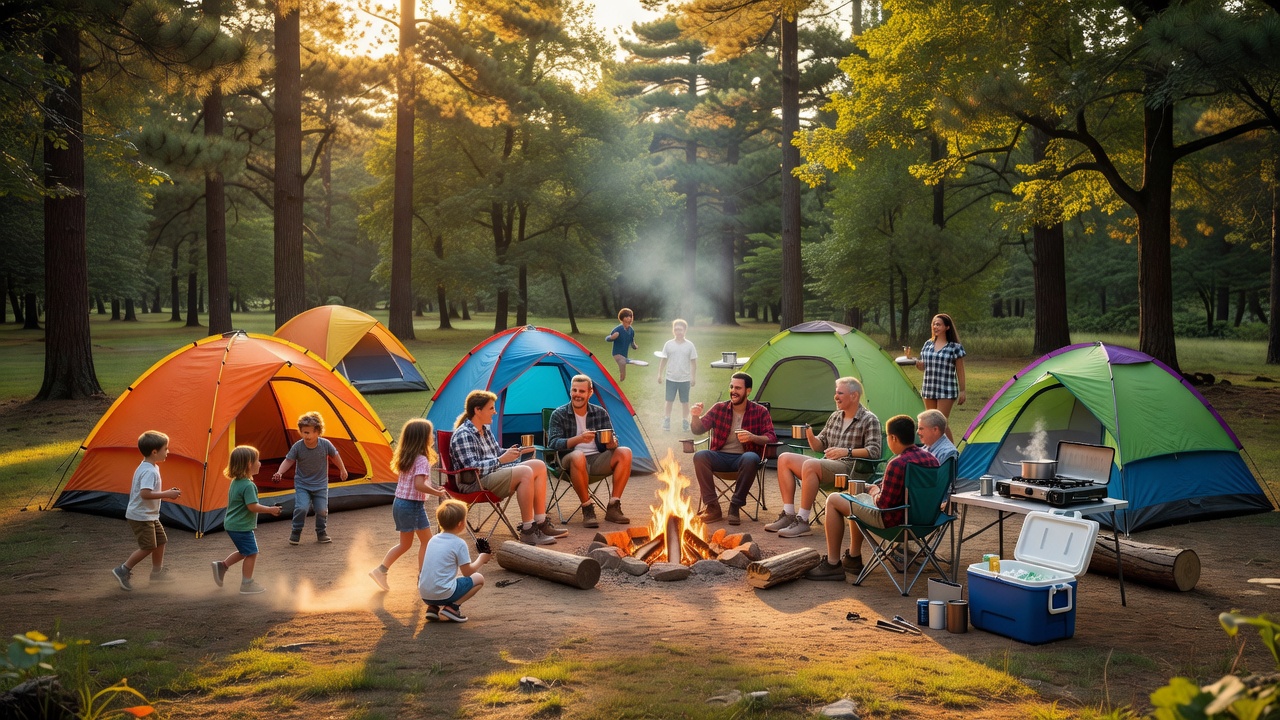
Step 3: The Meal Plan — One Family, One Meal
The most common group camping failure: everyone brings random food, the first family to arrive cooks for everyone (because they feel bad), and by the last day, half the food is spoiled and everyone's eating granola bars for dinner.
The assignment system:
| Meal | Who cooks | What |
|---|---|---|
| Friday dinner | Family A | Burgers, dogs, chips |
| Saturday breakfast | Family B | Pancakes, bacon, fruit |
| Saturday lunch | On your own | Leftovers, sandwiches |
| Saturday dinner | Family C | Chili or pasta (big batch) |
| Sunday breakfast | Family D | Breakfast burritos |
| Sunday lunch | On your own | Clean out the coolers |
Rules for group camp cooking:
- Each family buys, packs, and transports their assigned meal's ingredients
- The cooking family also handles cleanup for that meal (wash dishes, wipe tables, pack trash)
- Everyone else brings their own plates, utensils, and cups
- Family E/F (if you have more families) handles snacks, s'mores supplies, drinks, or a bonus meal
For more camp cooking inspiration, check out our camp cooking for beginners guide and outdoor camp meals guide.
Step 4: Campsite Layout — Where Everyone Goes
A group campsite isn't just a bunch of tents thrown anywhere. Bad layout creates noise conflicts (kids running through the cooking area), privacy issues (your tent faces the latrine), and safety hazards (campfires too close to sleeping areas).
The ideal group campsite layout has four zones:
-
Cooking zone (east side, upwind from tents): All stoves, coolers, prep tables, and wash station go here. Designate this area early and keep non-cooks out during meal prep.
-
Dining zone (adjacent to cooking): Picnic tables or camp chairs in a circle. Close enough to the kitchen that food doesn't get cold walking over, far enough that smoke doesn't blow into people's faces.
-
Social zone (campfire ring area): The fire pit, circle of chairs, and lantern area. This is where the group gathers after dinner. Keep it 20+ feet from tents — both for fire safety and so early sleepers aren't kept awake.
-
Sleeping zone (west side, away from fire): Tent clusters. Families with young kids together (they'll wake each other up anyway). Couples or solo campers farther away. Point tent doors away from the campfire to reduce light intrusion.
Pro tip: Bring flagging tape or glow sticks to mark tent guy lines. At night, someone WILL trip over them. On a group trip with 8+ tents, it's not a question of if — it's a question of how many times.
Step 5: Activities — Beyond the Campfire
Kids on a group trip entertain themselves surprisingly well. But it helps to have one structured activity per day so the adults get a break and the kids have something to look forward to.
Saturday morning: Nature scavenger hunt. Print a list (find: a Y-shaped stick, three different kinds of leaves, a smooth rock, animal tracks, something red) and send kids out in teams of 3-4. The winning team gets first pick of s'mores supplies.
Saturday afternoon: Group hike. Pick a trail that's 2-3 miles with minimal elevation — the goal is everyone finishing, not anyone suffering. Check our beginner hiking guide for trail selection tips.
Saturday evening: Campfire storytelling. Each family prepares one 3-minute story — funny, scary, or embarrassing camping story. Kids vote on the best one. Winner doesn't have to do dishes Sunday morning.
Rainy day backup: Card games tournament (Uno, Go Fish, Sushi Go), DIY birdhouse building (bring pre-cut wood kits), or a tent-to-tent board game rotation.
For more kid-focused activities, see our camping activities for kids guide.
Step 6: Money — The Uncomfortable Part You Must Address Upfront
Nothing sours a group camping trip faster than money resentment. One family feels they paid for everything. Another family doesn't realize they owe anything. By the drive home, the group chat is quiet and awkward.
The clean way to handle it:
-
Campsite fees: The coordinator books and pays. Everyone Venmos their share within 48 hours of booking. If someone can't commit, they don't Venmo — and they don't have a spot.
-
Group supplies (firewood, paper goods, communal snacks): One person buys, sends a photo of the receipt, and splits by family (not per person — a family of 5 pays the same as a family of 2 for shared supplies).
-
Meal ingredients: Each family covers their own assigned meal. No splitting, no tracking, no receipts. You cook for the group, they cook for you.
-
Specialty items: If one family brings an expensive item for the group (the YETI cooler, the Blackstone griddle), they're not owed money — they're contributing gear instead of cooking an extra meal. Gear contributions offset labor contributions.
The rule that prevents 90% of drama: All money is sent BEFORE the trip. Not during. Not after. "I'll Venmo you when we get home" is the most common broken promise in group camping.
Step 7: The Communication Plan
Group camping trips span multiple days with spotty cell service. You need a communication plan that works offline.
- Pre-trip: Create a shared note (Apple Notes, Google Keep, or a printed sheet) with: campsite address, check-in time, coordinator's phone number, nearest hospital, weather forecast, and the meal schedule. Everyone screenshots it before leaving home.
- At camp: Post the daily schedule on a whiteboard or clipboard at the cooking zone. Breakfast at 8. Hike at 10. Dinner at 6. No one has to ask "what's happening now?"
- Emergency: Identify the person with the best cell service at camp (walk the site and check bars). That person is the emergency contact. Give their number to the ranger station.
- Walkie-talkies: For large dispersed sites, a set of FRS walkie-talkies on channel 7 eliminates the "has anyone seen the kids?" panic that happens at least three times per trip.
Common Group Camping Mistakes (and How to Avoid Them)
Mistake 1: No arrival time window. Someone shows up at 9 AM. Someone else arrives at 7 PM. The early family sets up everything alone and feels resentful. Fix: Set a 2-hour arrival window. "We're arriving between 2-4 PM Friday." Anyone who can't make that window communicates it in advance.
Mistake 2: Too many cooks in the kitchen zone. Five people trying to make breakfast on two stoves in a 10×10 area becomes a contact sport. Fix: The cooking family owns the zone during their meal. Everyone else stays out. Offer to bring them coffee.
Mistake 3: Unrealistic meal ambitions. Someone volunteers to make "campfire paella with saffron rice and hand-rolled empanadas." This meal takes 2.5 hours to prepare and the kids are eating granola bars by 7:30 PM. Fix: One-pot meals only. Chili, pasta, tacos, breakfast burritos. If it requires more than one burner and a cutting board, it's too complex.
Mistake 4: No quiet hours agreement. One family wants to play guitar until midnight. Another family has a toddler who goes down at 7 PM. Fix: Agree on quiet hours before the trip. 10 PM to 7 AM is standard. The campfire can stay lit, but volume drops to conversation level.
Mistake 5: No rain plan. It will rain at some point. A group camping trip without a rain plan devolves into 20 people crammed into the biggest tent, slowly losing their minds. Fix: Bring at least two large pop-up canopies for the cooking/social zone. Tarps and paracord for a makeshift covered area. And board games — lots of board games.
Sample 3-Family Weekend Itinerary
Friday:
- 2-4 PM: Arrive, set up tents and camp
- 5 PM: Tent assignments, gear unpacking, site orientation for kids
- 6 PM: Family A cooks dinner
- 8 PM: Campfire, s'mores, stargazing
- 10 PM: Quiet hours begin
Saturday:
- 7 AM: Coffee available (coordinator brews first pot)
- 8 AM: Family B cooks breakfast
- 9:30 AM: Nature scavenger hunt (kids)
- 12 PM: Lunch on your own
- 1 PM: Group hike (2-3 miles)
- 4 PM: Free time — kids explore, adults relax
- 6 PM: Family C cooks dinner
- 8 PM: Campfire storytelling contest
- 10 PM: Quiet hours
Sunday:
- 7 AM: Coffee
- 8 AM: Family D cooks breakfast
- 9 AM: Pack personal gear
- 10 AM: Group cleanup — everyone picks up the site
- 11 AM: Departure (aim to be out by checkout time)
- 12 PM: Optional post-trip lunch at a nearby diner (decompression time)
The Best Group Camping Gear: Our Recommendations
If your group is investing in shared gear, here's what we'd prioritize:
For large-group cooking: The Coleman RoadTrip 225 ($124.99) + Coleman 2-in-1 Grill & Stove ($114.99) combo handles any group meal under 20 people. Grill on one, boil/stir-fry on the other.
For the family tent setup: The EVER ADVANCED 6 Person ($169.99) is the sweet spot of price, setup speed, and livable space. For a deeper comparison across sizes, see our camping tent size guide and best family camping tents comparison.
For hydration: On a group trip, you'll go through more water than you think. The Sawyer Squeeze filter ($34.95) turns any nearby stream into drinking water. For more water options, check our water purification guide.
For cooling: If your group site is a walk from parking, the YETI Tundra Haul ($400) is an investment, but its wheels and bear-proof certification make it the standard for serious group campers.
Ready to Plan Your Group Trip?
Group camping trips are the memories your kids will talk about at Thanksgiving when they're 25. They'll remember the year Uncle Dave accidentally set the pancake batter on fire. The time all seven kids built a fort from downed branches that was structurally questionable but spiritually magnificent. The morning someone brewed coffee for the whole campsite and became a hero.
The coordination is real work — but it's front-loaded. Set up the spreadsheet, assign the meals, agree on quiet hours, and the trip itself runs on momentum. The group handles the details you'd normally stress about alone.
Start planning now. Summer weekends book up fast — especially group sites.
More group trip resources:
- Complete Family Camping Checklist — print this and bring it
- Camp Kitchen Setup Guide — how to organize the cooking zone
- Camping Trip Planning Guide — permits, reservations, and logistics
- Family Camping Weekend Packing Guide — what to pack per family
- Yosemite Family Camping Guide — if you're aiming for the big one