How to Use Trekking Poles: A Complete Guide for Hikers Who Want to Save Their Knees
Trekking poles aren't just for old hikers. Learn how to use them correctly for uphill power, downhill protection, and crossing streams — plus how to choose the right pair for your hiking style.
I spent my twenties making fun of trekking poles. They looked like ski gear for people who couldn't ski. Every hiker I passed with poles seemed overdressed for a walk in the woods — like wearing a wetsuit to the community pool.
Then I hiked the Four Pass Loop in Colorado. Fifteen miles, 7,800 feet of elevation gain, four mountain passes above 12,000 feet. By mile ten my knees were sending me invoices for future medical bills. A stranger at the third pass handed me one of his poles for the descent. The difference was immediate — my knees stopped screaming on every step down, and I finished the loop with functioning legs.
I bought my own poles the next week and haven't hiked without them since. Here's what I've learned.
Why Trekking Poles Actually Work (It's Not Just Marketing)
The science is straightforward: trekking poles transfer some of your body weight from your legs to your arms and shoulders. On flat ground, that's about 20% load reduction on your knees and ankles. On steep descents — where the impact on your joints is highest — it can be 25-30%.
A 2018 study in the Journal of Sports Sciences found that hikers using poles reported significantly less muscle soreness in the legs and lower back after a full day of hiking compared to hikers without poles. The effect was most pronounced on descents, where eccentric muscle contractions (the kind that make you sore) are highest.
But there's more to it than joint protection. Poles improve your balance on uneven terrain. They act as probes for stream crossings and snow fields. They can push thorny branches out of your way. And they give your upper body something to do — hiking becomes a full-body workout instead of just a leg burner.
Choosing the Right Trekking Poles
Trekking poles come in three materials and two adjustment styles. Here's how to pick.
Carbon vs. Aluminum
Carbon fiber poles like the LEKI Makalu FX Carbon ($169.95) are lighter (around 16-18 oz per pair), absorb vibration better, and don't transfer cold to your hands the way aluminum does. The trade-off: carbon can crack under severe lateral force rather than bend. For most hikers doing day hikes and weekend backpacking trips, carbon is the sweet spot — light enough that you barely notice them on your pack, strong enough for everything short of using them as a pry bar.
Aluminum poles are heavier (20-24 oz per pair) but nearly indestructible — they bend before they break, and a bent pole still works. If you're a heavier hiker (200+ lbs), bushwhacking off-trail, or notoriously hard on gear, aluminum is the safer bet.
The LEKI Makalu FX Carbon hits a nice middle ground: the carbon shaft keeps weight down while the SpeedLock 2 external locking mechanism is one of the most reliable adjustment systems on the market. LEKI's AERGON cork grips mold to your hand over time and wick sweat better than foam or rubber in hot conditions. At $169.95, they're an investment — but LEKI poles routinely last 5+ years of heavy use.
Fixed vs. Adjustable
Adjustable poles (two or three sections with telescoping locks) let you change length for different terrain. Shorten them for steep climbs, lengthen them for descents. They also collapse down small enough to strap to your pack. This is what most hikers should buy.
Fixed-length poles are lighter and simpler but can't adapt to terrain. Reserve these for trail runners and ultralight thru-hikers who prioritize every gram.
Grip Material
Cork: Best all-around. Molds to your hand, wicks moisture, doesn't get slippery when wet. Slightly heavier than foam.
Foam: Lightest and softest. Great moisture absorption. Wears faster than cork.
Rubber: Found on cheap poles. Gets slippery and causes blisters in hot weather. Only useful for winter hiking with gloves — rubber insulates better in the cold.
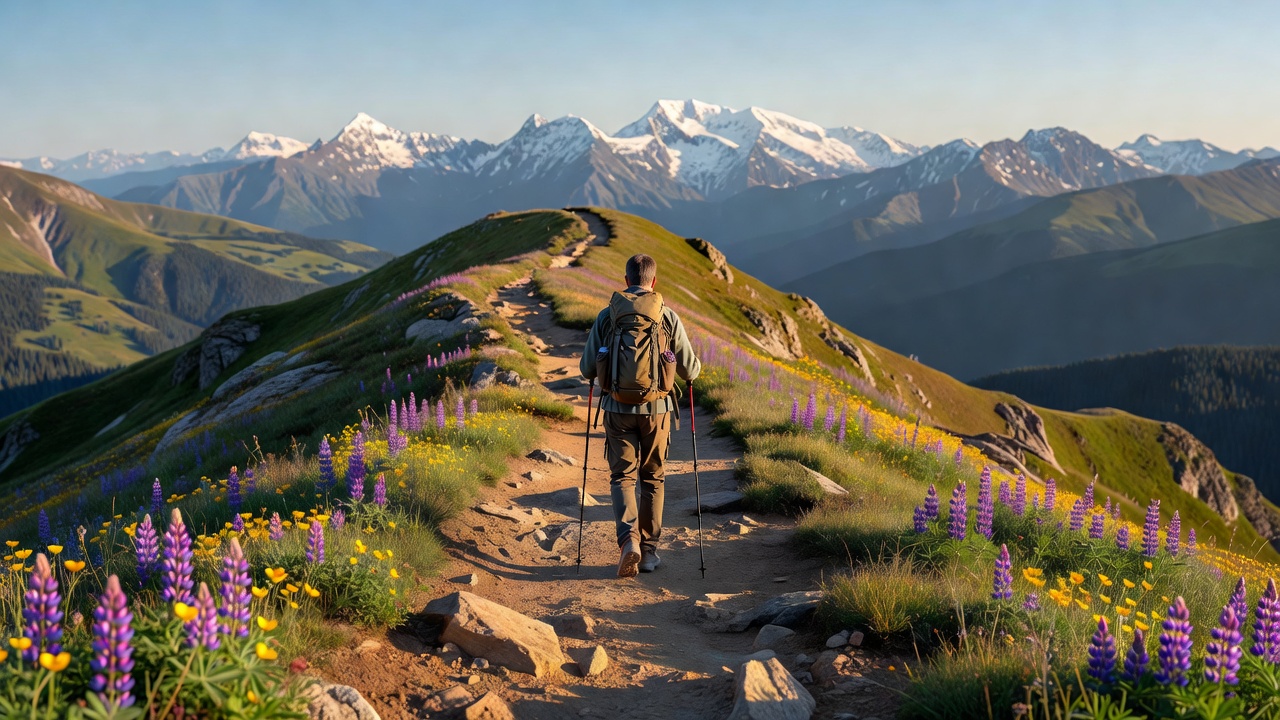
How to Set Trekking Pole Height
Most people set their poles too high or too low and never adjust them on the trail. Here's the proper starting point and terrain adjustments.
Base height: Stand on flat ground with your arm at your side. Adjust the pole until your elbow is at a 90-degree angle when you grip the handle. Your forearm should be parallel to the ground.
Uphill adjustment: Shorten poles by 5-10 cm. This lets you plant the pole ahead of you and pull yourself up without overextending your shoulder.
Downhill adjustment: Lengthen poles by 5-10 cm. This gives you a stable plant below your center of gravity, reducing the impact on each step down.
Traversing a slope: Shorten the uphill pole, lengthen the downhill pole. This compensates for the slope angle so both arms stay in a natural position.
One of the best things about the LEKI SpeedLock 2 system is that it's adjustable with one hand — no unscrewing, no fiddling with twist locks that get jammed with trail dust. You flick the lever, slide, flick it closed. When you hit a steep section, you adjust in three seconds and keep moving.
Grip Technique That Prevents Fatigue
The most common mistake I see is the death grip — squeezing the handle like you're holding onto a cliff edge. Your hands will cramp within an hour.
The correct grip: hold the handle firmly but not tight, like you're shaking hands with a friend. Your fingers wrap around the grip, thumb over the top. The wrist strap is NOT optional — it's the secret to endurance.
How to use the wrist strap correctly: Reach UP through the strap from below, then grip the handle. The strap should sit between your hand and the pole, wrapping around your wrist. When you plant the pole, push down through the strap rather than squeezing the handle — the strap transfers force to your wrist and forearm, and your hand muscles can stay relaxed. You should be able to open your fingers while walking and still control the pole through the strap alone.
This technique matters because your hands and wrists fatigue much faster than your legs. When your hands cramp, you naturally grip harder, which makes the cramping worse, which makes you want to stash the poles and hike without them. The strap breaks that cycle.
The Walking Rhythm
Trekking poles work best with a natural alternating rhythm — right foot forward with left pole plant, left foot forward with right pole plant. This is the opposite of how most beginners instinctively use them (same-side planting), which creates an awkward waddle.
If you struggle with the rhythm, try counting: "left pole, right foot" as you walk. It clicks within about ten minutes on the trail. Don't think too hard about it — your body figures out the contralateral pattern faster than your brain does.
For flat and gentle terrain, use a light double-plant: both poles tap the ground roughly at the same time, alternating with your steps. This is less efficient than contralateral planting but feels natural at a relaxed pace.
For steep climbs, plant both poles ahead of you simultaneously, pull yourself up, step, repeat. Your arms do about 20% of the climbing work — it feels like using handrails on stairs.
For descents, plant both poles slightly ahead and below you before each step down. The poles take the impact first, then your foot lands. Your quads still work — but your knees absorb dramatically less shock on each step.
Essential Gear That Pairs With Your Poles
Trekking poles change how you pack and what you carry.
Backpack compatibility: You need a pack with pole attachment points — either side compression straps or a dedicated pole-carry system. The Osprey Talon 22 ($140) has stretch mesh side pockets and Stow-on-the-Go trekking pole attachment that lets you stash your poles without taking off the pack. When you hit a scramble section where poles are useless, you can secure them in about five seconds. The 22-liter capacity is ideal for day hikes with layers, food, and a hydration reservoir.
Hydration: Poles mean both hands are occupied, so reaching for a water bottle in your pack's side pocket requires stopping. A hydration reservoir like the CamelBak Crux ($42) solves this — sip from the hose while walking, poles in both hands. The Crux delivers 20% more water per sip than older CamelBak designs, which matters when you're breathing hard on a climb and don't want to suck on a straw for five seconds to get a mouthful.
For more on staying hydrated on the trail, see our summer hiking hydration guide.
Navigation: When both hands are on poles, pulling out your phone for navigation is awkward. A wrist-worn GPS like the Garmin Instinct 2S Solar ($199.99) puts navigation, altitude, and distance on your wrist. The solar model charges from sunlight while you hike — on a sunny five-hour day hike, you can gain back several days of battery life. It's waterproof to 100 meters, so stream crossings and rain aren't concerns.
When NOT to Use Trekking Poles
Poles aren't right for every situation. Here's when to stow them:
Scrambling sections: Any terrain where you need both hands on rock. Stash your poles on your pack. The Osprey Talon's Stow-on-the-Go system makes this a 5-second transition.
Narrow, brushy trails: When manzanita and scrub oak are grabbing at everything. Poles become snag hazards and slow you down more than they help.
Paved or hardpacked flat sections: On pavement, pole tips skid and the metal-on-rock sound is annoying. Use the rubber tip covers (included with most poles) or just carry them.
Running: Poles are for hiking. Trail runners use a different rhythm entirely. If you're alternating between running and walking, use collapsible poles that fit inside your pack when not in use.
Common Mistakes to Avoid
Leaning the poles forward too far. Your poles should plant roughly even with or slightly ahead of your body. Planting way out in front turns them into brakes, not propulsion aids. You'll tire your shoulders and slow yourself down.
Never adjusting pole length. If you set your poles once in the parking lot and never touch them again, you're missing half the benefit. Adjust at every major terrain change. The LEKI SpeedLock system makes this a three-second adjustment — there's no excuse.
Using poles as tent poles without checking compatibility. Some ultralight trekking-pole tents are designed specifically for this (your poles replace dedicated tent poles). But don't assume your trekking poles will work with any random tent — check the tent specs first.
Dragging poles behind you. I see this constantly: hikers carrying poles but not actually planting them. They dangle from wrist straps, scraping along the ground. Either use them or stow them. Dragging poles wears down the carbide tips and the scraping noise annoys everyone within earshot.
Skipping the baskets. Those little plastic discs near the tip are not decorative. Use small baskets (included with most poles) for dirt and rock trails, wide baskets (sold separately) for snow and mud. Without baskets, your poles sink into soft ground and the plant becomes useless.
The "One Pole" Emergency Backup
On long solo hikes, some hikers carry a single collapsible pole as emergency gear rather than a dedicated pair. One pole provides about 70% of the stability benefit on descents and serves double duty as a splint, tent support, or wildlife deterrent. It's not ideal for all-day comfort, but it's a smart weight-savings strategy for ultralight packers.
For most hikers though, two poles are worth the extra 8 ounces. The bilateral support protects both knees equally, and the alternating rhythm feels natural after a few miles.
Getting Started: A Two-Week Training Plan
If you've never used poles, don't expect to love them on mile one. It takes a few hikes for the rhythm to feel natural. Here's how to ramp up:
Hike 1 (3-5 miles, easy terrain): Focus purely on grip and strap technique. Walk on flat or gently rolling trail. Don't worry about the alternating rhythm yet — just get comfortable holding the poles and using the straps correctly.
Hike 2 (5-8 miles, mixed terrain): Add the contralateral rhythm (opposite arm, opposite foot). Practice adjusting pole length for short uphill and downhill sections. Your arms might feel tired — that's normal. You're using muscles that haven't worked on hikes before.
Hike 3 (8+ miles, significant elevation): Full integration. Use rhythm on flats, double-plant on steep climbs, brake on descents. Adjust pole length at every terrain change. By the end of this hike, the poles should feel like extensions of your arms rather than foreign objects.
After three dedicated training hikes, most hikers never go back. The poles feel weird when they're missing — like driving without a seatbelt.
For more hiking fundamentals, check out our complete beginner's guide to hiking. If you're planning an overnight trip, see our backpacking vs car camping comparison and our solo camping tips. For hot-weather hiking, our summer hiking clothing guide covers what to wear.
The Bottom Line
Trekking poles are the single most underrated piece of hiking gear. They protect your knees, improve your balance, engage your upper body, and make stream crossings less terrifying. A quality pair like the LEKI Makalu FX Carbon ($169.95) will last years and pay for itself in joint longevity alone.
Pair them with a hydration-compatible pack like the Osprey Talon 22 ($140) and a hydration reservoir like the CamelBak Crux ($42), and you have a day-hiking setup that keeps you moving efficiently from trailhead to summit and back.
The first few miles will feel awkward. Push through. Your knees will thank you for decades.
<!-- AFFILIATE_DISCLOSURE -->